Traditional Dance & Music
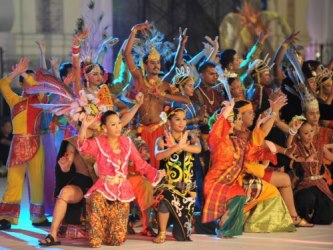
Malaysia's multi-cultural and multi-racial heritage is most prominently
exhibited in its diverse music and dance forms. The dances of the indigenous
Malay, Orang Asli and different ethnic peoples of Sabah and Sarawak are truly
exotic and enchanting. As the Chinese, Indians and Portuguese settled in
Malaysia, the traditional dances of their homelands became a part of Malaysia's
culture and heritage.
DANCE
Malay Mak Yong
Originating from Patani in Southern Thailand, Mak Yong was conceived to
entertain female royalty, queens and princesses, when their men were away at
war. Combining romantic drama, dance and operatic singing, tales of the golden
age of the Malay kingdoms are dramatised in enchanting performances.
Kuda Kepang
Kuda Kepang is a traditional dance brought to the state of Johor by Javanese
immigrants. Dramatising the tales of victorious Islamic holy wars, dancers sit
astride mock horses moving to the hypnotic beats of a percussion ensemble
usually consisting of drums, gongs and angklungs.
Zapin
Islamic influence on Malaysian traditional dance is perhaps most evident in
Zapin; a popular dance in the state of Johor. Introduced by Muslim missionaries
from the Middle East, the original dance was performed to Islamic devotional
chanting to spread knowledge about the history of the Islamic civilisation.
Joget
Malaysia's most popular traditional dance, is a lively dance with an upbeat
tempo. Performed by couples who combine fast, graceful movements with playful
humour, the Joget has its origins in Portuguese folk dance, which was introduced
to Melaka during the era of the spice trade.
Tarian Lilin
Also known as Candle Dance, it is performed by women who do a delicate dance
while balancing candles in small dishes.
Silat
One of the oldest Malay traditions and a deadly martial art, Silat is also a
danceable art form. With its flowery body movements, a Silat performance is
spellbinding and intriguing.
Chinese Lion Dance
Usually performed during the Chinese New Year festival, Lion Dance is energetic
and entertaining. According to the legend, in ancient times, the lion was the
only animal that could ward off a mythological creature known as Nian that
terrorised China and devoured people on the eve of the New Year. Usually
requiring perfect co-ordination, elegance and nerves of steel, the dance is
almost always performed to the beat of the tagu, the Chinese drum, and the
clanging of cymbals.
Dragon Dance
The dragon is a mythical creature that represents supernatural power, goodness,
fertility, vigilance and dignity in Chinese culture. Typically performed to
usher in the Chinese New Year, the Dragon Dance is said to bring good luck and
prosperity for the year to come. Usually requiring a team of over 60 people,
this fantastic performance is a dazzling display of perfect co-ordination, skill
and grace.
Indian Bharata Natyam
This classical Indian dance is poetry in motion. Based on ancient Indian epics,
this highly intense and dramatic dance form uses over 100 dance steps and
gestures. As mastery requires many years of practice, some children begin
learning the dance form at the age of five.
Bhangra
Bhangra is a lively folk music and dance form of the Sikh community. Originally
a harvest dance, it is now part of many social celebrations such as weddings and
New Year festivities. Typically centred around romantic themes with singing and
dancing driven by heavy beats of the dhol, a double-barreled drum, the bhangra
is engagingly entertaining.
Sabah & Sarawak Ngajat
The Warrior Dance is a traditional dance of Sarawak's Iban people. This dance is
usually performed during Gawai Kenyalang or 'Hornbill Festival'. Reputedly the
most fearsome of Sarawak's headhunters, the tribe's victorious warriors were
traditionally celebrated in this elaborate festival. Wearing an elaborate
headdress and holding an ornate long shield, the male warrior dancer performs
dramatic jumps throughout this spellbinding dance.
Datun Julud
The Hornbill Dance is a traditional dance of Sarawak's Kenyah women. Created by
a Kenyah prince called Nyik Selong to symbolise happiness and gratitude, it was
once performed during communal celebrations that greeted warriors returning from
headhunting raids or during the annual celebrations that marked the end of each
rice harvest season. Performed by a solo woman dancer to the sounds of the sape,
beautiful fans made out of hornbill feathers are used to represent the wings of
the sacred bird.
Sumazau
Sumazau is a traditional dance of Sabah's Kadazan people. Usually performed at
religious ceremonies and social events, it is traditionally used to honour
spirits for bountiful paddy harvests, ward off evil spirits and cure illnesses.
Male and female dancers perform this steady hypnotic dance with soft and slow
movements imitating birds in flight.
Bamboo Dance
Another highly popular and entertaining traditional dance is Bamboo Dance. Two
long bamboo poles are held horizontally above the ground at ankle-height. They
are clapped together to a high-tempo drumbeat. Requiring great agility, dancers
are required to jump over or between the poles without getting their feet
caught.
Orang Asli
The traditional dances of the Peninsular Malaysia's Orang Asli are strongly
rooted in their spiritual beliefs. Dances are commonly used by witch-doctors as
rituals to communicate with the spirit world. Such dances include Genggulang of
the Mahmeri tribe, Berjerom of the Jah-Hut tribe and the Sewang of the Semai and
Temiar tribes.
The Portuguese of Melaka Farapeira
The Farapeira is a fast, cheerful dance usually accompanied by guitars and
tambourines, performed by couples dressed in traditional Portuguese costumes.
Branyo
Favoured mainly by the older Portuguese generation, compared to the Farapeira
the Branyo is a more staid dance. Male dancers dressed in cowboy-like costumes
and female dancers dressed in traditional baju kebayas with batik sarongs sway
to the steady rhythm of drums and violins.
MUSIC
Orchestra
Malaysia has two traditional orchestras: the gamelan and the nobat. Originally
from Indonesia, the gamelan is a traditional orchestra that plays ethereal
lilting melodies using an ensemble of gong percussion and stringed instruments.
The nobat is a royal orchestra that plays more solemn music for the courts using
serunai and nafiri wind instruments.
Musical Instruments
Rebana Ubi
In the days of the ancient Malay kingdoms, the resounding rhythmic beats of the
giant rebana ubi drums conveyed various messages from warnings of danger to
wedding announcements. Later, they were used as musical instruments in an
assortment of social performances.
Kompang
Arguably the most popular Malay traditional instrument, the kompang is widely
used in a variety of social occasions such as the National Day parades, official
functions and weddings. Similar to the tambourine but without the jingling metal
discs, this hand drum is most commonly played in large ensembles, where various
rhythmic composite patterns are produced by overlapping multiple layers of
different rhythms.
Gambus
Brought to Malaysia by Persian and Middle Eastern traders, the gambus or Arabian
oud is played in a variety of styles in Malay folk music, primarily as the lead
instrument in Ghazal music. Carefully crafted with combinations of different
woods, this instrument produces a gentle tone that is similar to that of the
harpsichord.
Sape
The sape is the traditional flute of the Orang Ulu community or upriver people
of Sarawak. A woodcarving masterpiece with colourful motifs, the sape is made by
hollowing a length of wood. Once played solely during healing ceremonies within
longhouses, it gradually became a social instrument of entertainment. Typically,
its thematic music is used to accompany dances such as the Ngajat and Datun
Julud.